


Search
Structure and Management
The University is headed by the Rector, who is responsible for the overall condition and development of the University, as well as for the lawful and prudent use of its financial resources. According to the University’s Statutes, the rectorate serves as the Rector’s advisory body, comprising the Vice Rector for Academic Affairs and the Administrative and Finance Director. The rectorate is tasked with ensuring the comprehensive development of the University by fulfilling its objectives through the co-ordination of the activities of its structural units and by maintaining organisational cohesion.
The highest collegial decision-making body of the University is the 15-member University Council, whose members are elected internally for a term of three years. The Council consists of three members of the rectorate, eight representatives of teaching staff from different study programmes, and four representatives of the student body.
The Assembly of Councillors is an 11-member advisory body that serves as a link between the University and the society. It makes proposals regarding the University’s development to the Rector, the Council, and the Ministry of Education and Research. The Assembly of Councillors includes representatives of different organisations (ministries, hospitals, etc.). The members of the Assembly of Councillors are appointed by the Minister of Education and Research, and their terms of office are indefinite.
The Student Council is a representative body of up to 21 members elected by the students of the University for the purpose of bearing responsibility and organising student affairs. It aims to protect students’ rights and interests, represent the student body, and appoint representatives for this purpose, including to the Council, as well as to promote student life. The Student Council is elected for a term of one year.
The Working Environment Council is a six-member collaborative body of employer and employee representatives, elected for a four-year term whose purpose is to discuss and address issues related to occupational health and safety at the University. The Working Environment Council analyses working environment issues, reviews the results of working environment risk assessments and internal audits, and makes proposals to the rectorate for improving the working environment and implementing preventive measures.
The purpose of the Pedagogical Board is to ensure the quality of teaching, ensure that the learning environment is suitable for achieving the objectives of the study programmes, develop the study programmes, and organise teaching and development work. R&D activities are co-ordinated by the Research and Development Board, which analyses, monitors and makes proposals to the Council regarding the University’s strategic goals for R&D, activities outlined in the action plan, and key performance indicators.
Working groups operate across the University to systematically support the development of the institution, the teaching quality, and study process, as well as interdisciplinary co-operation. Working groups are either temporary, formed to achieve a specific development goal, or permanent, supporting the University’s strategic priorities and continuous development. Depending on the goal, members of the development teams include students as well as academic and non-academic staff of the University.
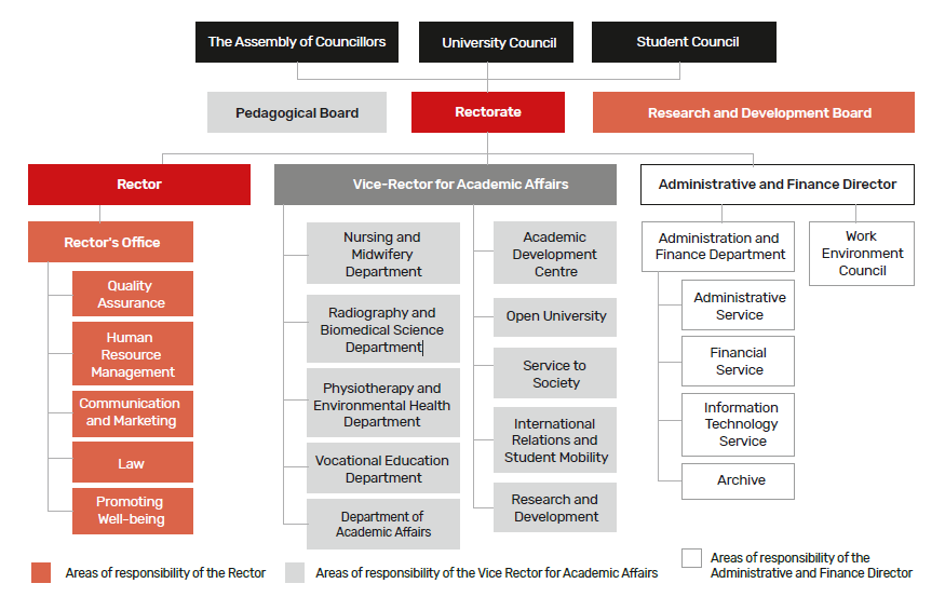
Structure of the University as at 31 December 2025


