


Search
Quality Assurance
Tartu Applied Health Sciences University is a state institution of professional higher education administered by the Estonian Ministry of Education and Research in the fields of health and social care. The University operates pursuant to the legislation regulating higher education and vocational education as well as the University’s Statutes. The activity of the university is based on different national strategic documents.

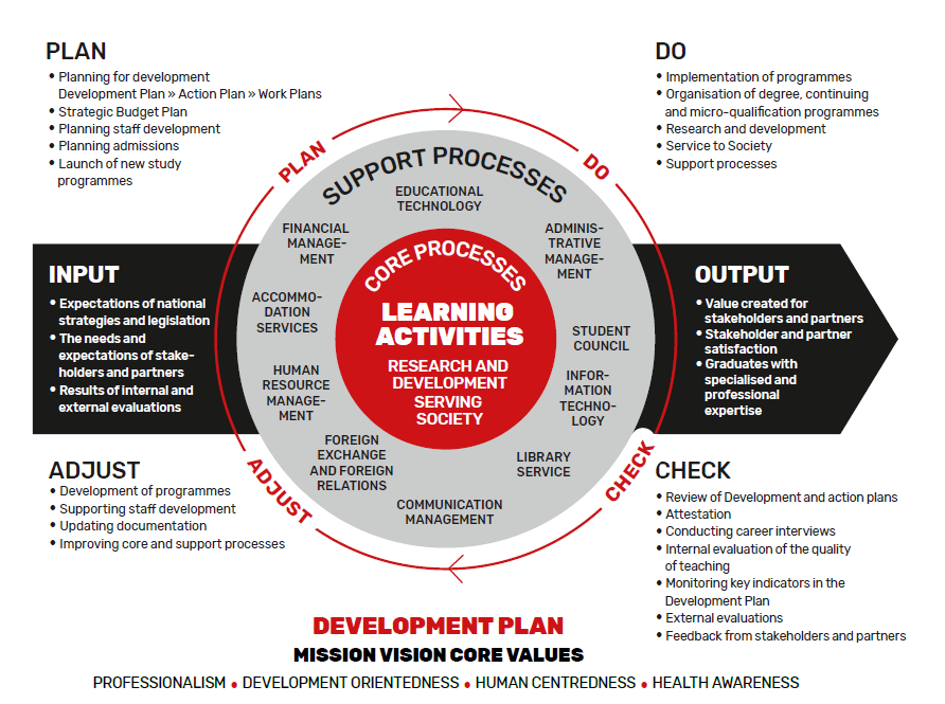
The University is guided by the principles of process-based management, whereby the University’s core activities are carried out through core processes. Focus is placed on holistic processes rather than individual activities, which create real value for interested parties – students, employees, partners, and society at large.
The strategic management of the University is supported by its quality system, which is based on the Plan-Do-Check-Adjust (PDCA) model. It links goal setting, implementation of activities, assessment of results and performance, and planning for improvements. Strategic management is supported by the Development Plan 2021–2026, the University’s mission, vision and core values.
The cycle is aimed at creating value for the University’s stakeholders and partners, ensuring stakeholder satisfaction, and preparing graduates with the specialised and professional expertise needed by society and the labour market.
1. PLAN – planning for development
The Development Plan 2021-2026 is a continuation of the previous development plan, at the same time including the revised vision and mission of the university as well as a fresh interpretation of the core values that serve as a basis for the performance of the university. For the period 2021-2026, five strategic objectives with corresponding sub-objectives have been defined. The key indicators of development are presented across the fields of activity.
Planning is based on the Development Plan 2021–2026, which defines the University’s strategic objectives and development priorities. Planning also covers staff development, admissions and the launch of new study programmes. The planning process takes into account national strategies and legislation, the needs and expectations of stakeholders and partners, and the results of internal and external evaluations.
2. DO – implementation
The Development Plan is implemented through the Action Plan and annual work plans, supported by the strategic budget plan. The renewed action plan 2024-2026 (previous one 2021-2025) is setting specific tasks for each calendar year, the responsible persons, deadlines, as well as the budget strategy, including the investment plan. The action plan and the budget strategy are approved by the College Council.
Planned activities are implemented through the University’s core processes – learning activities, research and development, and serving society – and through its support processes. These include degree studies, continuing and micro-qualification programmes, R&D activities, societal engagement and the administrative and other support services that enable the core processes.
3. CHECK – evaluation and monitoring
Implementation and performance are regularly evaluated through the review of the Development Plan and Action Plan, staff attestation, career interviews, internal evaluations of teaching quality, monitoring of key indicators and external evaluations. Feedback from students, staff, graduates, employers, educational institutions, minisrties and other partners is also used to assess performance and identify areas for improvement. The achievement of strategic objectives is monitored using quantitative and qualitative key indicators.
4. ADJUST – improvement and further development
Based on the results of monitoring and evaluation, the University makes adjustments to its programmes, staff development, documentation and core and support processes. The results of this stage feed into the next planning cycle, supporting continuous improvement and development.
Good Practice of Teaching and Studying was created and adopted in 2023 by all the members of the University to encompass the principles of core values that are followed in studying and teaching. This Good Practice is established in communication among the University members and others in study, development, and research activities in classrooms and digital environments. The aim of Good Practice is to shape a good ethical climate at the University, raise awareness concerning best practices for the University members, and prevent and detect early possible deviations from the Good Practice.
Best practices for Management were formulated and adopted in 2023 to develop the governance and organisational culture, with the aim of highlighting and maintaining a focus on the governance principles linked to the University’s core values, which guide the actions of the University’s management.
Recognized University
The Higher Education Assessment Council of the Estonian Quality Agency for Higher and Vocational Education decided on April 27 in 2020 to accredit Tartu Applied Health Sciences University for 7 years. The accreditation is valid until April 27, 2027.
The Council recognises Tartu Applied Health Sciences University for its activities as a health promoter and leader of healthy behaviour in society, as well as for the involvement of learners in different types of community activities. The university is having a leading role in the development of new study programmes and professional standards in the field of health care. An individual approach to each learner is implemented in the study process. Stakeholder satisfaction with the university activities is high; high satisfaction is also reflected in the performance of dedicated lecturers and administrative staff. The university has thoroughly planned the activities for introducing specialities trained at the university.
Assessment of vocational education and training curricula took place in conjunction with the institutional accreditation in 14.-18.10.2019. Based on the Assessment Council decision of March 10, 2020, the next quality assessment of the following study programme groups: social work and counselling, child care and youth services, therapy and rehabilitation, medical diagnostic and treatment technology, will take place after six years.


